Service Recovery (Coming Soon)
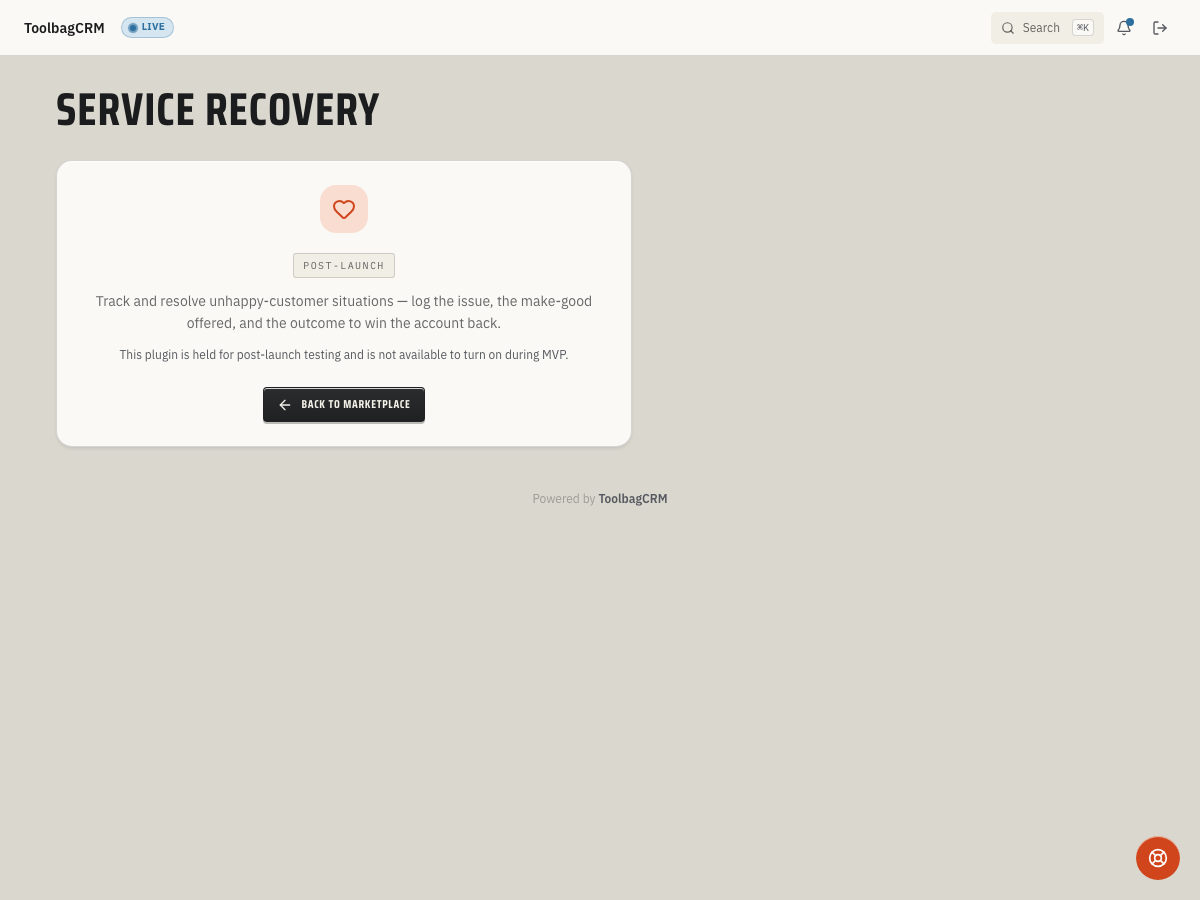
Coming Soon: Service Recovery is a public preview and is not generally available yet. Your account will show a coming-soon placeholder until the full case workflow is enabled, so this guide describes the planned customer workflow.
Service Recovery gives your team a structured way to respond when something goes wrong on a job — a missed appointment, a rude technician, a failed repair, or a billing mistake. Instead of ad-hoc apologies and scattered follow-ups, the plugin provides a formal recovery case with assigned ownership, a step-by-step plan, a resolution deadline, and a root-cause record so the same failure does not repeat.
When to use this
Use Service Recovery when your team needs to turn a negative customer experience into a retention win. Common triggers include:
- A customer leaves a low NPS score or a negative review after a completed job.
- A support ticket escalates because a technician missed an appointment or damaged property.
- A callback is triggered because a repair failed within days of the original visit.
- An owner or manager receives a direct complaint that needs formal tracking.
- A billing dispute or invoice error damages customer trust.
The plugin is distinct from Customer Support (inbound ticket queue) and Callbacks (return-trip ledger). Service Recovery is the recovery plan layer — it coordinates the apology, compensation, and corrective action across those other workflows.
Before you start
- Confirm the plugin is included in your plan.
- Open Settings → Features and make sure Service Recovery is enabled.
- The plugin requires Customers to be active.
- Decide who can open, assign, and resolve recovery cases. Most teams restrict this to owners, office managers, or customer-experience leads.
Planned workflow
Once the full workspace is available, the planned lifecycle is:
1. Open a recovery case
A case is opened for a specific customer, linked to the originating failure signal. Each case captures:
- Customer — the affected account.
- Severity — Minor, Moderate, Major, or Critical (determines the resolution deadline).
- Summary — a brief description of what went wrong.
- Failure source — where the issue came from: complaint, negative review, low NPS, callback, support ticket, or internal escalation.
Severity drives the resolution SLA window:
| Severity | Resolution deadline |
|---|---|
| Minor | 72 hours |
| Moderate | 48 hours |
| Major | 24 hours |
| Critical | 4 hours |
2. Build a recovery plan
Each case supports a series of recovery steps — the specific actions your team will take to make things right. Step types include:
- Call customer — an apology or status call from a manager or owner.
- Email customer — a written follow-up with next steps.
- Schedule visit — a return trip to correct the issue.
- Issue refund — partial or full refund for the affected work.
- Issue credit — a service credit applied to the customer account.
- Escalate to manager — route the case to a decision-maker.
- Write apology letter — a formal written apology.
- Photos of correction — document the fix for the record.
- Internal training note — log the coaching or process change.
- Root cause analysis — identify and tag the underlying cause.
Each step is completed, skipped, or marked failed, with notes capturing what happened.
3. Resolve the case
Resolution requires:
- Resolution type — Apology Only, Make-Good Service, Partial Refund, Full Refund, Comped Service, Service Credit, Written Letter, Combined, or Customer Declined All.
- Root cause tag — a required tag from your team's taxonomy (e.g., "installer-rudeness," "wrong-part-on-truck," "scheduling-mistake").
- Prevention action — what your team will do to prevent the same failure.
Resolution is not accepted without a root-cause tag — the system enforces this so every closed case contributes to trend analysis.
4. Track root-cause trends
Over time, the plugin clusters root-cause tags across cases. If six cases this quarter share the tag "installer-rudeness," that pattern surfaces as a training signal. This turns individual recovery moments into systemic improvement.
Compensation
When a recovery includes financial make-good, the plugin coordinates with your existing payment and credit systems:
- Refunds — issued through your payment processor and recorded on the case.
- Service credits — applied to the customer account via the Customer Credits plugin.
- Comped future services — scheduled through quotes or membership plans.
Each compensation action is linked to the recovery case for audit purposes.
Tips
- Treat every recovery case as a retention opportunity. Research shows customers who experience a failure and then an exceptional recovery rate the company higher than customers who never had a problem.
- Set severity honestly. A Critical property-damage case should hit the 4-hour window; a Minor scheduling complaint can wait 72 hours.
- Use root-cause tags consistently. The trend analysis only works when your team uses the same vocabulary for the same failures.
Troubleshooting
The plugin shows a coming-soon placeholder
That means the full workspace is not available for your account yet. Use this guide to plan the workflow before rollout.
Can I open a case manually today?
Wait until your account shows the Service Recovery workspace before training the team on manual case creation.