On-Call & Emergency Dispatch
On-Call & Emergency Dispatch helps you plan after-hours coverage, see who is responsible for urgent calls, and track how quickly the team responds when a customer needs help outside normal hours.
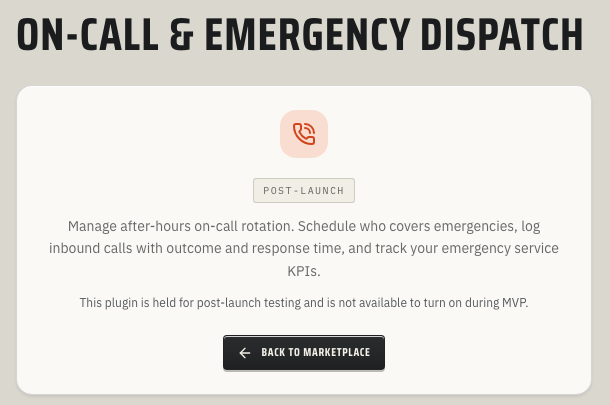
Not available to turn on right now. On-Call & Emergency Dispatch is held for post-launch rollout and cannot be enabled from Settings → Features during the current release. The workflow below describes how the plugin works once it ships so you know what to expect — administrators cannot self-serve enable it yet.
When to use this
Use On-Call & Emergency Dispatch when your company offers emergency service, weekend coverage, or rotating after-hours support and needs one place to schedule coverage shifts and record emergency calls.
Common uses include:
- Assigning the technician who is responsible for after-hours calls.
- Logging emergency calls that come in overnight or on weekends.
- Tracking whether the issue was dispatched, resolved by phone, declined under policy, or missed.
- Reviewing average response time against your company response target.
Before you start
- On-Call & Emergency Dispatch is not yet available to enable — it is held for post-launch rollout, so there is no working Settings → Features toggle during the current release.
- Make sure team members are already set up, because on-call shifts are assigned to technicians or coverage owners.
- Decide who on your team should be allowed to create shifts, activate or complete them, and update on-call setup once the plugin is released.
- Decide the response-time target your team wants to measure against.
- Decide how after-hours calls should be handed off while the plugin is unavailable, so the future workflow can match your current coverage policy.
Schedule an on-call shift
When the plugin is released, the planned shift workflow is:
- Open On-Call & Emergency Dispatch from the ToolbagCRM navigation.
- Select New Shift.
- Enter the technician name, shift start time, shift end time, and any coverage notes.
- Save the shift.
- Use the status tabs to review active, scheduled, completed, or cancelled shifts.
The dashboard shows how many shifts are active or scheduled, how many emergency calls were logged this month, and the average response time compared with your SLA target.
Log an emergency call
Emergency call logging happens from a scheduled or active shift once the plugin is available.
- Open the shift.
- Select Log Call.
- Enter the customer name, phone number, when the call was received, and the issue description.
- Choose the outcome: Dispatched, Resolved, No Answer, or Declined.
- Add the response time, related job title, or notes if needed.
- Save the call log.
Use the outcome field consistently so managers can distinguish true truck rolls from issues handled by phone.
Settings
When the plugin is released, administrators with On-Call write access can open the setup page to tune:
- Default shift length — used to prefill the end time when creating a new shift.
- Rotation cadence — daily, weekly, every two weeks, or monthly. The setting records the preferred cadence; automatic rotation is planned separately.
- Emergency contact number — the number customers should use for after-hours emergencies.
- Response-time SLA target — the target minutes used for the response-time dashboard tone.
- Auto-notify preference — records whether inbound emergency calls should alert the on-call technician. Automatic notification is planned separately.
Tips
- Keep the emergency contact number and escalation policy current before advertising after-hours coverage to customers.
- Use short coverage notes for handoff details such as backup technicians, geographic limits, or special customer instructions.
- Review declined and no-answer outcomes regularly; they often reveal policy gaps or schedule coverage issues.
- Start with one dispatch manager owning the process before letting the whole team edit shifts after release.
- Keep using your current after-hours handoff process until the On-Call workspace is available in your account.
Troubleshooting
On-Call & Emergency Dispatch is not available to enable
This is expected right now. The plugin is held for post-launch rollout, so the post-launch card does not lead to a working toggle yet — there is no enable action available during the current release.
The setup page says you do not have access
Once the plugin is available, on-call setup is account-wide. Ask an administrator to grant write access for this plugin if you need to change shift defaults, emergency routing, or SLA targets.
The shift list is empty
After the plugin ships, create the first shift with New Shift. If you expected existing shifts, check the status filter: you may be viewing only active, completed, or cancelled shifts.
Average response time shows a dash
The dashboard needs logged calls with response times before it can calculate an average. Add response minutes when logging emergency calls if you want the SLA card to be useful.
A shift cannot be deleted
Only scheduled or cancelled shifts can be deleted. If a shift is already active or completed, use the normal lifecycle actions and keep the record for coverage history.