Customer Financing
Customer Financing helps you offer in-house installment plans for larger jobs directly from ToolbagCRM, then track the payment schedule, overdue installments, and collection status without a separate spreadsheet.
When to use this
Use Customer Financing when a customer wants to move forward with a high-ticket job but needs to pay over time. It is designed for jobs such as HVAC replacements, repiping, electrical panel upgrades, and other projects where your office wants to manage the payment plan inside the CRM instead of handing the relationship to a third-party lender.
Before you start
- Confirm Customers is available, because each plan should be tied to a customer record.
- Open Settings → Features and make sure Customer Financing is enabled for your account.
- Decide the default term, APR, and down-payment policy your team should quote.
- Limit setup access to administrators or office managers who are allowed to configure financing terms.
Settings
- Go to Customer Financing.
- Select the plugin settings link in the page header.
- Set the default term in months, default APR, and default down-payment percentage.
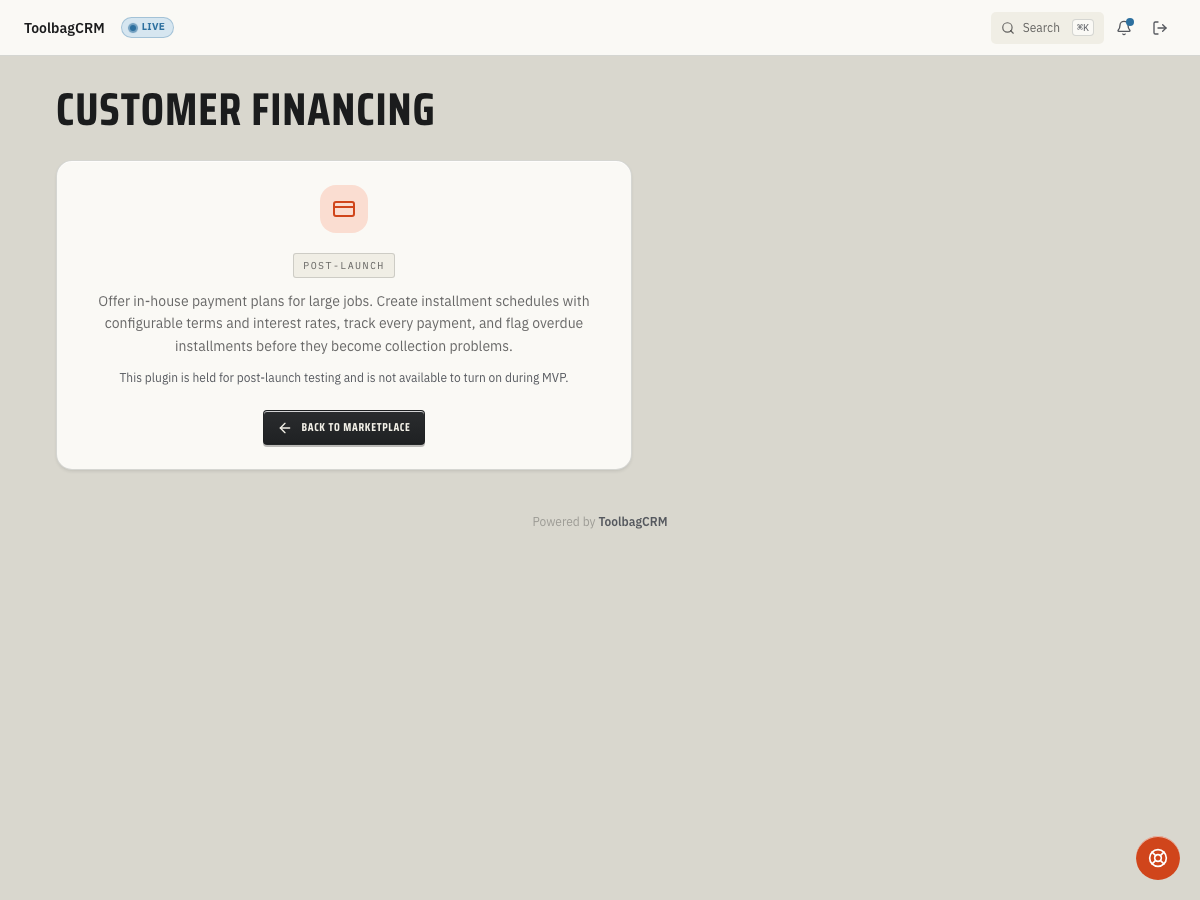
- Record your preferred late fee and grace period. ToolbagCRM stores these values for policy reference; automated late-fee handling is marked as coming soon in the product settings.
- Save the settings.
The defaults help the New Plan form start with the terms your team uses most often. A user can still override the total, down payment, term, APR, and start date on an individual plan.
Create a financing plan
- Open Customer Financing.
- Select New Plan.
- Enter the customer name and job or project name.
- Add the total amount and any down payment.
- Choose the term in months and APR.
- Review the estimated monthly payment shown in the form.
- Add the start date and any notes your office needs.
- Select Create Plan.
New plans start as Proposed. The plan list shows the customer, job, financed amount, monthly payment, term, start date, and status so the office can review the offer before activating it.
Activate and manage installments
- Select a proposed plan from the list.
- Review the plan summary: total, down payment, financed amount, monthly payment, term, APR, start date, and progress.
- Select Activate when the customer accepts the plan.
- Confirm activation to generate the monthly installment schedule.
- Use Record on an installment when payment is received. The payment dialog starts with the installment amount and lets you record the payment date and notes.
- Use Waive only when an installment should be forgiven. Waived installments count as settled for plan progress.
ToolbagCRM tracks progress such as 4/24 paid and advances the plan as installments are paid or waived. If every installment is settled, the plan can move to completed status automatically.
Tabs, search, and collections
The Customer Financing page includes tabs for All Plans, Active, and Overdue so the office can separate proposed plans from active collection work. Use the search field to find a customer or job quickly. Dashboard tiles summarize total plans, proposed plans, active plans, overdue installments, total financed amount, collected month-to-date, and completed plans for the year.
Use the Overdue tab during collections reviews so delinquent installments are visible without opening each customer record one by one.
Tips
- Set your defaults first. Before creating any plans, open the plugin settings and set your preferred term, APR, and down-payment percentage. Every new plan inherits these values, so configuring them once saves your team from re-entering the same numbers on each offer.
- Keep plans in Proposed until the customer signs off. A proposed plan is an offer, not a commitment. Activate it only after the customer agrees to the terms — activation generates the installment schedule and starts the clock on the first due date.
- Use the Overdue tab during weekly collections review. The Overdue filter isolates late installments so your office does not have to scan every active plan. Check it at least once a week to catch delinquent payments early.
- Record partial payments with a note. When a customer pays less than the full installment amount, use Record with the actual amount received and add a note explaining the situation. The installment moves to PartiallyPaid status so the shortfall stays visible.
- Reserve Waive for exceptional cases. Waiving an installment marks it as settled and removes it from the overdue count. Use it sparingly — for goodwill gestures or billing errors — and always add a note explaining why.
- Review the dashboard tiles before offering new plans. The stat cards show total financed amount and collected month-to-date. If your outstanding financing exposure is high, you may want to tighten terms or require a larger down payment on new plans.
Troubleshooting
I cannot open financing setup
The settings screen requires write access to Customer Financing. Ask an administrator to grant the permission or make the setup change for you.
Late fees are not being added automatically
The settings screen stores late-fee and grace-period preferences, but the product marks automated late-fee handling as coming soon. Until that automation is available, use the stored policy as office guidance and handle fees through your normal billing process.